
How to Write an APA Research Paper
We’ll break down the writing process into easy steps to help you understand how to write a research paper fast no matter how long it must be.
The following steps will help you write a research paper, starting with nothing but an assignment or prompt and ending up with a well-crafted essay. The steps are:
- Get familiar with the assignment
- Pick a topic
- Research
- Organize research
- Form a thesis
- Create an outline
- Write
- Edit for content
- Edit for grammar
- Re-read and submit your paper
Step 1. Choose a Topic
When you comprehend what you're being approached to write in your examination paper, it's an ideal opportunity to choose what to expound on. This can be overwhelming, yet don't get excessively angry. It tends to be extremely useful to expound on something you're keen on or enthusiastic about, however, don't stress over picking the ideal point. As a rule, a questionable subject can be perfect, with the goal that you can practice your capacity to unbiasedly clarify varying positions, and even guard one if the task requires that.

Utilize the rules given by your teacher to help pick your paper subject. If you have a point that you love, yet you're experiencing difficulty fitting it into the rules, pick another subject. It will be simpler for you over the long haul to expound on a theme that fits the task. It's critical to be occupied with the subject you're expounding on it, however, you don't need to cherish it. It's likewise great to understand that you can utilize this examination composing task as a chance to find out about something new. You will be to some degree a specialist in the theme before the finish of this procedure, however, you don't need to know it all at this moment.
Step 2. Write a Working Thesis Statement
Set up a working postulation before you really arrange your exploration since it will direct your examination and will assist you with remaining concentrated regarding your matter. Your theory proclamation ought to be succinct and mirror the kind of paper you are composing. All examination papers can be separated into 3 classifications:
contentious or convincing if you are contending the end;
explanatory when you clarify data;
diagnostic when you present your examination of certain data.
 You need to commit enough of your valuable time to make a decent solid theory articulation so your undertaking has a reasonable reason. Your proposal should be easy to refute and limit because your cases ought to be bolstered by proof. On the off chance that your case is expansive, you will require more proof to persuade your perusers that you are correct. Here is a case of a far from being obviously true postulation proclamation:
Environmental change is the most squeezing test confronting the present reality.
Step 3. Do Research on Your Topic
You should find enough secondary and primary credible sources on the subject of your paper, carefully read all of them, and find relevant evidence to support your thesis. At this stage, you should evaluate your sources, take notes, and start documenting your sources according to a citation style specified by your instructor (APA, MLA, Chicago, Harvard, etc.)
Make sure you use the latest edition of a specific style guide. You will use your notes about references later when writing your paper and building your bibliography. It’s crucial to cite all sources that you used for quoting, paraphrasing, and summarizing to avoid plagiarism.
Step 4. Make a Good Outline
Your research has given you tons of great ideas. Now you have to organize them for your impressive presentation. Don’t skip this vital step because without it, your project will lack focus and you will need more time for revising your draft trying to make sense of your jumbled thoughts. That’s why you need an outline. You have to finalize your thesis and create a working outline that you plan to cover and that will serve you as a roadmap and keep you focused.
Think about the key points that you’ll need to develop to support your thesis statement. You can use them as subheadings for the body of your paper. Look through your notes and organize the information under each sub-heading. Make sure you include only relevant information that fits under your sub-headings and directly supports your thesis.
You should resist the temptation to include any information that doesn’t fit into your outline no matter how interesting it is.
When writing an outline, you should keep in mind a typical research paper structure that commonly includes:
- a title page;
- an abstract;
- an introduction;
- a methodology section;
- findings/results;
- discussion;
- conclusion.
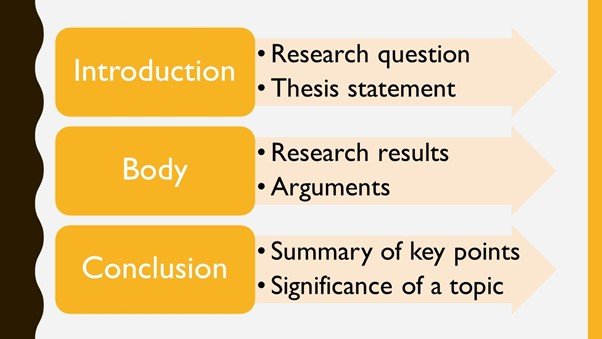
But if your research paper is not long, its format may include an introduction, body paragraphs, and a conclusion. In any case, you should follow specific guidelines provided by your instructor.
Step 5. Create the First Draft
This is the middle of the process. You have a clear direction and it’s time to create the first draft with a title, in-text citations, and a reference page.
The title is very important if you want to make a good impression on your readers because it’s the first thing that they see. It forms their view on what exactly they should expect in your paper. You should list the keywords that present the topic of your paper, the methods you used, and the results that you achieved. Now create a sentence that includes all the keywords that you have listed and delete the unnecessary words. After that, you need to link the remaining ones. Finally, you have to delete non-essential info and organize the remaining words in the logical order. You can also include the subtitle. Make sure that your title is concise.
Afterward, you need to write an introduction, body paragraphs, and a conclusion. These are the main parts of your paper so let us provide you with some details on how to do it right.
How to Write an Introduction for a Research Paper
Start writing an intro. The introductory paragraph should begin with an attention grabber that may be:
★ a provocative question;
★ statistics;
★ an anecdote;
★ unusual facts, etc.
You are writing an academic paper but that doesn’t mean you have to be boring. Next, you need to provide the background information, explain your goals, and how you plan to approach your research paper topic. You should finish your introduction with your thesis statement or research question. This section of your paper is not long so you are sure to finish it fast.
How to Write Body Paragraphs
Your outline will help you to complete this part of your paper. But you shouldn’t think that you must strictly follow it. It may evolve and you are free to revise it and make changes. The key thing is to stay on your track and focus on your thesis. You should provide your points and support your main idea.
Start each body paragraph with a topic sentence and provide arguments and relevant evidence to support it. You should write as many body paragraphs as you have the key points.
How to Write a Conclusion for a Research Paper
Most research papers end with restarting their thesis statements. You can also do it but you shouldn’t repeat it word for word. Paraphrase it or summarize the key points of your paper. You may emphasize the significance of your findings as well. A good idea is to provide some recommendations based on the results of your investigation or suggest some directions for further research.
Your rough draft is ready. Wondering what to do next? Go on reading to find some tips on how to revise your research paper.
How to Make Your Paper Perfect
No one can write their first draft perfectly. So, if you want to make a good impression on your professor and earn a high grade, you should revise your draft to make sure that your project is on point. Be ready that you may need to revise your project more than once because it is really worth doing.
Step 6. Revise, Edit and Proofread

You have to make large-scale changes and check the logic, flow, transitions, make changes in the structure and order of your paragraphs. You should make sure that all your ideas are fully developed and all the claims are supported by credible evidence. You may need to add some section headings.
The next stage is editing. You have to check and eliminate filler words and phrases, improve word choice, and correct mistakes in punctuation and grammar if you find any. You should look for:
- incomplete sentences;
- dangling modifiers;
- easily confused words (such as to, too, and two);
- spelling mistakes;
- apostrophes for possessives and plurals;
- quotation rules obeyed;
- comma use;
- eliminate contractions.
You will need to re-read your paper several times. A good strategy is to read your paper backward. In this way, you will feel a little disoriented and will be able to catch more mistakes. You should start reading the last sentence, then check the second to the last one and continue doing it until you get to your first sentence.
You should ask your friends or family members to review your research paper and express their opinion about it. They should evaluate your argument, transitions, and the balance and look for any inconsistencies with usage, grammar or mechanics. Ask your friends to provide their feedback and make suggested changes if you think they make sense. Finally, you may print your paper and proofread it to eliminate minor mistakes or typos and ensure that your amazing research paper is flawless.
Step 7. Rely on Our Academic Custom Writing Service
You can use our easy guide to craft winning research papers fast, get better grades, and enjoy your life in college. Alternatively, you can address our specialists to write a research paper for you. As a result, you’ll spend less time but get more pleasure from studying at university.


0 Comments